
Why referral pressure starts upstream
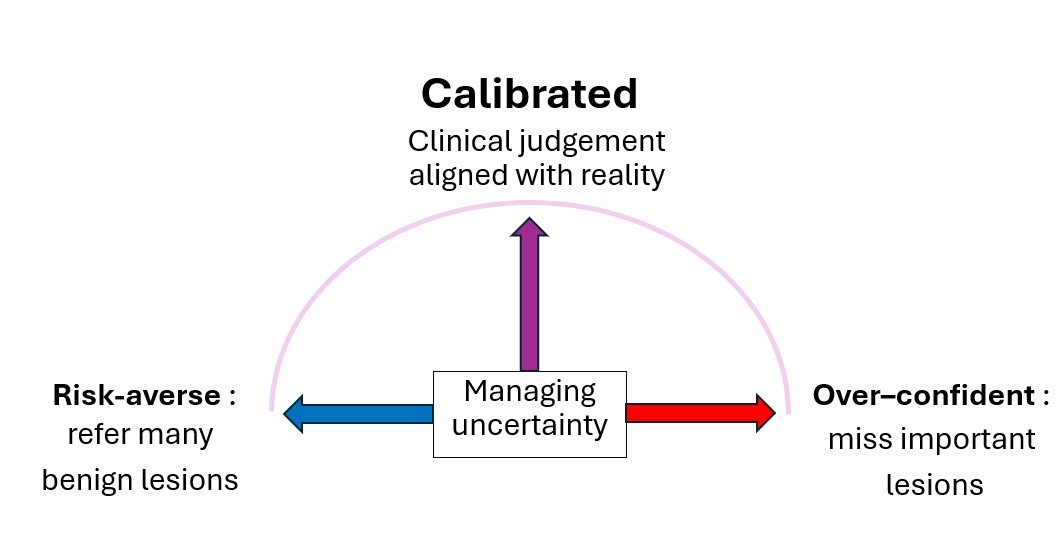
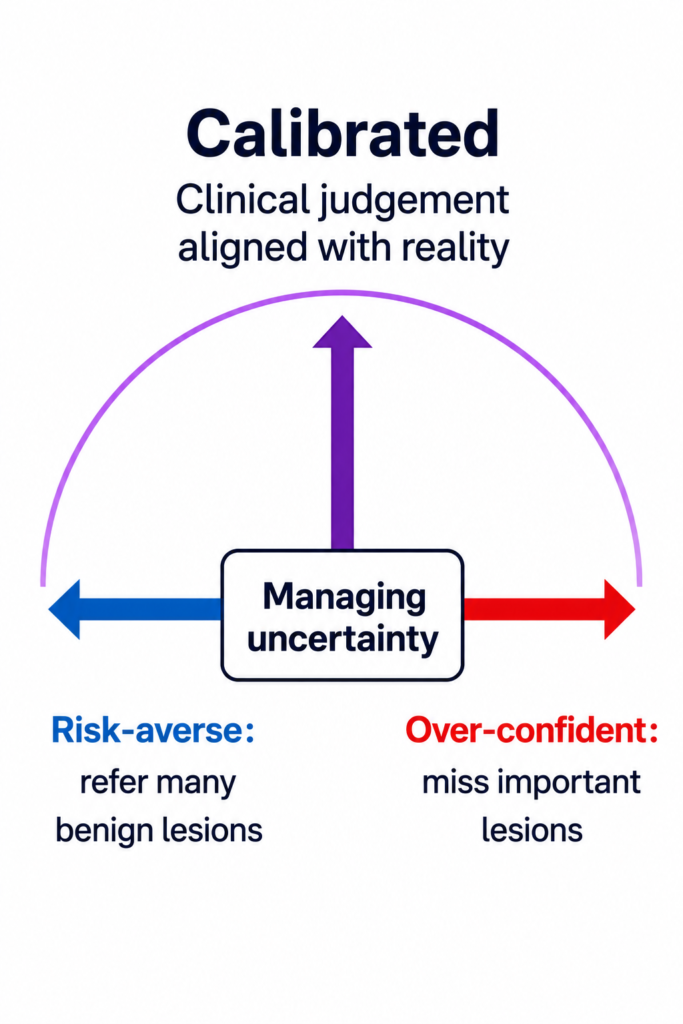
Most referrals begin with a difficult decision made under uncertainty
Without meaningful feedback, decision thresholds drift over time — increasing variation and pressure downstream
Why decisions don’t improve naturally
Clinical judgement can drift in either direction without sufficient case volume and outcome-linked feedback.
Expected outcomes
What changes
Over the course of a pilot, you should expect to see measurable changes in system performance.
→ At the point of decision
Unnecessary referrals reduce, while high-risk lesions are escalated more consistently.
→ Across clinicians
Variation reduces, with more consistent decision thresholds.
→ Across the pathway
More patients are managed at first contact, and cancer conversion rates increase.
→ Over time
Decision accuracy improves in a measurable and auditable way.
Each participating practice runs dedicated spot clinics for skin lesion assessment. Decisions are recorded at first contact and linked to subsequent outcomes. Regular review and supervision allow those outcomes to be used for learning while clinicians continue working within existing referral pathways and governance arrangements.
Further details of the clinical learning model and day-to-day operation of the programme can be found on the Clinicians & Practices page. practice:
DermCAP operates within existing clinical and governance frameworks. Clinical responsibility remains with the GP, existing referral pathways are unchanged, and decisions are supported by clear escalation thresholds. Outcomes are tracked for both referred and non-referred lesions to support learning and evaluation. No patient-identifiable data leaves the practice.
Performance is assessed using your existing system data.
Referral rates, 2WW activity and cancer conversion rates are reviewed alongside decision-level tracking within DermCAP. This allows the pilot to be evaluated using your own data, within your existing system.
A typical DermCAP pilot is a structured, time-limited programme designed to test this approach in real clinical settings.
The pilot typically involves 3–5 practices, one participating clinician per practice, and runs for 13 months including an initial calibration phase.
DermCAP is designed to work within existing primary care systems. Participating clinicians require protected clinical time, minimal administrative support (typically around 30 minutes per month), and access to referral and outcome data for evaluation.
Calibration is the process of adjusting clinical judgement against real patient outcomes so that decisions more accurately reflect the actual risk of the skin lesion being assessed.
DermCAP enables safe calibration by combining concentrated case exposure, outcome-linked learning, supervision and structured feedback. This helps clinicians progressively align their judgement with real-world risk while maintaining existing governance and referral pathways.
Calibration is not a one-off event. It is a way of working that compounds and improves over time.uild safer, more consistent decision-making that becomes progressively better aligned with real clinical risk over time.
The pilot is designed to test this approach safely within your existing system.
If it demonstrates value, it can be continued and expanded. If it does not, it can be concluded with no disruption to existing referral pathways.
→ Continue and scale
If it does not:
→ Stop, with no disruption to existing pathways
DermCAP provides a structured way to test and improve decision-making — using your own clinicians, your own patients, and your own data.
Following evaluation, systems can decide whether to continue, expand or conclude the programme based on local outcomes and priorities.
Next step
Assess whether DermCAP fits your system.